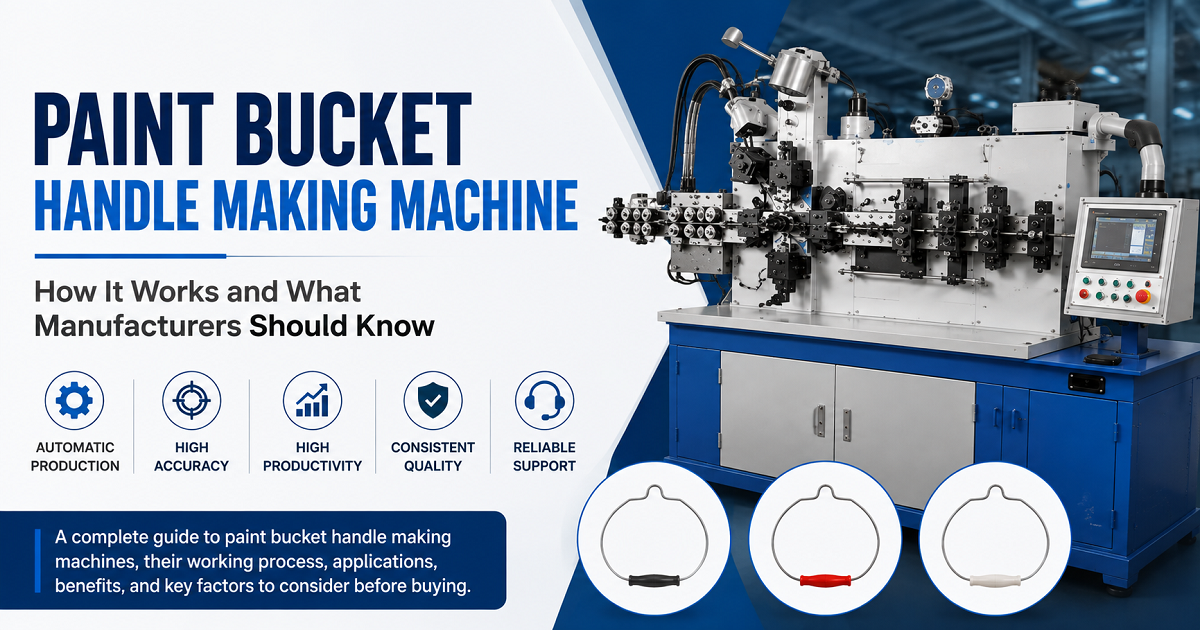
Paint buckets and cans require strong, accurately formed handles for convenient handling, transportation, and storage. As production volumes increase, manually manufacturing these handles can become difficult to manage consistently. A paint bucket handle making machine provides an automated solution for producing wire handles with repeatable dimensions and shapes.
For paint, coating, chemical, and industrial packaging manufacturers, choosing the right machine depends on factors such as wire specifications, handle design, production requirements, and the desired level of automation.
What Is a Paint Bucket Handle Making Machine?
A paint bucket handle making machine is specialized equipment designed to manufacture wire handles used with paint buckets, paint cans, coating containers, and other industrial packaging products.
The manufacturing process can combine several operations, including wire feeding, straightening, cutting, bending, shaping, and handle forming. By automating these repetitive processes, manufacturers can improve production consistency and reduce dependence on manual operations.
How Does a Paint Bucket Handle Machine Work?
The exact process depends on the machine configuration and required handle design. However, the basic production process generally includes several stages.
1. Wire Feeding
The machine starts by feeding wire into the processing system. Consistent wire feeding helps maintain accuracy during the subsequent manufacturing stages.
2. Wire Straightening
Before forming, the wire is straightened to prepare it for accurate cutting and bending. Proper straightening is important for maintaining consistent handle dimensions.
3. Wire Cutting
The wire is automatically cut to the required length based on the selected handle design. Consistent cutting helps reduce variations between individual handles.
4. Bending and Shaping
After cutting, the wire is bent and shaped according to the required specifications. The forming mechanism determines the final shape and dimensions of the handle.
5. Final Handle Formation
The final forming operation completes the required handle geometry. Depending on the design, additional operations such as notching may also be included.
Applications of Paint Bucket Handle Machines
A paint bucket handle making machine can be used for producing handles for various types of containers.
Paint Buckets and Cans
Paint manufacturers require handles that match the dimensions and design of their containers. Automated machinery can help produce consistent handles for different paint packaging formats.
Coating Containers
Handles can also be produced for containers used for coatings and related industrial products.
Chemical Containers
Industrial and chemical packaging may require specially designed wire handles based on container dimensions and handling requirements.
Industrial Packaging
The same type of wire-forming technology can be used for other industrial containers where durable and accurately formed handles are required.
Benefits of Automated Paint Bucket Handle Production
Consistent Handle Dimensions
Automated cutting and forming processes can help maintain uniform dimensions and shapes throughout production.
Higher Production Efficiency
Automation can streamline repetitive manufacturing operations and help manufacturers manage larger production requirements.
Reduced Manual Operations
By combining multiple wire-processing stages, the machine can reduce repetitive manual handling.
Improved Production Accuracy
Controlled wire feeding, cutting, bending, and forming can help minimize variations during production.
Flexible Manufacturing
Machine configurations can be developed according to factors such as wire diameter, handle dimensions, handle shape, and production requirements.
What Should Manufacturers Consider Before Buying?
Selecting a paint bucket handle making machine requires more than comparing machine prices. Manufacturers should first understand their production requirements.
Wire diameter: Confirm the wire size and material required for your handle design.
Handle dimensions: Define the required length, width, bends, and overall geometry.
Production capacity: Estimate the number of handles required per hour or day.
Automation: Determine which operations need to be automated, including feeding, cutting, bending, and forming.
Customization: If your paint buckets have a unique handle design, discuss customization requirements with the machine manufacturer.
Technical support: Installation, commissioning, maintenance guidance, spare parts, and after-sales support are also important considerations.
Paint Bucket Handle Making Machine Manufacturer in India
Ramji Engineering Works manufactures wire-forming and wire-processing machinery, including solutions designed for paint bucket handle production. Its Paint Bucket Handle Making Machine is designed to automate major stages such as wire feeding, straightening, cutting, bending, shaping, and final handle forming.
The machine can be configured according to requirements such as handle design, wire diameter, dimensions, and production needs. Ramji Engineering Works also provides installation, commissioning, operator guidance, technical support, maintenance guidance, and spare-parts assistance.
Conclusion
A paint bucket handle making machine can help manufacturers create a more consistent and efficient wire-handle production process. Automated feeding, straightening, cutting, bending, and forming can reduce repetitive manual work while improving production control.
Before selecting a machine, manufacturers should evaluate their wire specifications, handle design, production capacity, automation requirements, customization needs, and technical support. Choosing machinery based on these factors can help create a reliable production setup for paint bucket and industrial container handles.