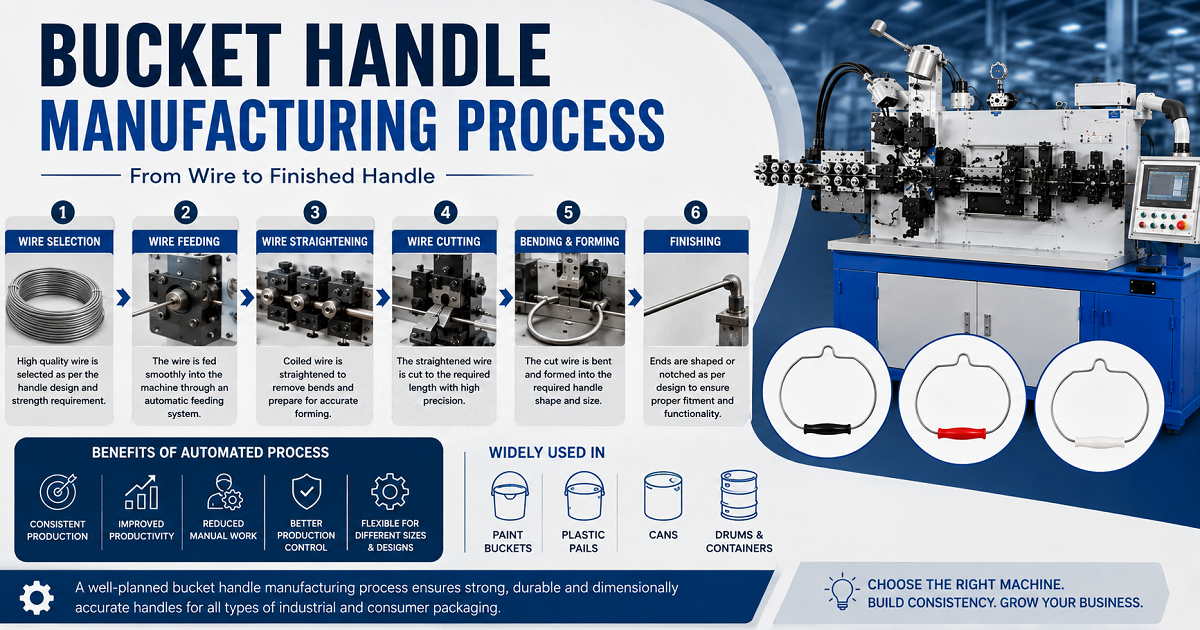
Bucket handles are widely used in paint buckets, plastic pails, cans, drums, and industrial containers. Producing these handles consistently requires accurate wire processing and forming. A modern bucket handle manufacturing process can combine several operations into a streamlined production cycle.
For manufacturers, understanding each stage helps in selecting suitable machinery and maintaining consistent product quality.
1. Wire Selection
The manufacturing process begins with selecting the appropriate wire according to the required handle design. Wire diameter, material, strength, and finish can vary depending on the application and container type.
The selected wire should be compatible with the forming and cutting requirements of the production machine.
2. Wire Feeding
The wire is supplied to the forming machine through a controlled feeding system. Consistent feeding is important because irregular wire movement can affect cutting accuracy and the final handle shape.
Automated feeding can help maintain a stable production process and reduce repetitive manual handling.
3. Wire Straightening
Coiled wire naturally contains bends and curves. Before it can be accurately formed, the wire is passed through a straightening system.
Proper straightening prepares the wire for accurate cutting and bending and helps maintain consistency between finished handles.
4. Wire Cutting
Once the wire has been straightened, it is cut according to the required handle dimensions. Accurate cutting is essential because the length of the wire directly affects the final size and shape of the handle.
Automated cutting can help manufacturers maintain consistent lengths throughout production.
5. Bending and Forming
The cut wire is then bent into the required handle shape. Depending on the product design, the forming process may involve multiple controlled bends.
This stage determines important characteristics such as the handle’s width, height, curvature, and overall geometry.
6. Finishing Operations
Some handle designs require additional operations such as notching or specific end formations. These processes help prepare the handle for fitting or assembly with the container.
The exact finishing requirements depend on the handle design and application.
Benefits of Automated Bucket Handle Manufacturing
Automation can bring several advantages to manufacturers producing handles in regular or large quantities.
Consistent Production
Automated feeding, cutting, bending, and forming can help maintain consistent handle dimensions across production batches.
Improved Productivity
Integrating multiple operations into a machine can create a smoother production workflow and reduce repetitive manual tasks.
Reduced Manual Handling
Automation minimizes the need for operators to manually perform every cutting and forming operation.
Better Production Control
Manufacturers can work with defined machine settings and production parameters to achieve repeatable results.
Choosing the Right Bucket Handle Making Machine
The ideal machine depends on several factors, including:
- Wire diameter and material
- Handle dimensions
- Handle shape and design
- Required production volume
- Automation level
- Finishing requirements
- Customization needs
Ramji Engineering Works manufactures wire forming and wire processing machinery, including bucket handle making machines designed to automate operations such as wire feeding, straightening, cutting, bending, and handle forming. The company states that its machines can be customized according to product dimensions and production requirements.
Conclusion
A well-planned bucket handle manufacturing process combines suitable wire material with accurate feeding, straightening, cutting, bending, and forming operations. For manufacturers looking to improve production consistency and reduce repetitive manual work, automated wire-forming machinery can provide a more streamlined production setup.
Before selecting machinery, manufacturers should evaluate their handle design, wire specifications, production volume, and customization requirements to identify the right manufacturing solution.