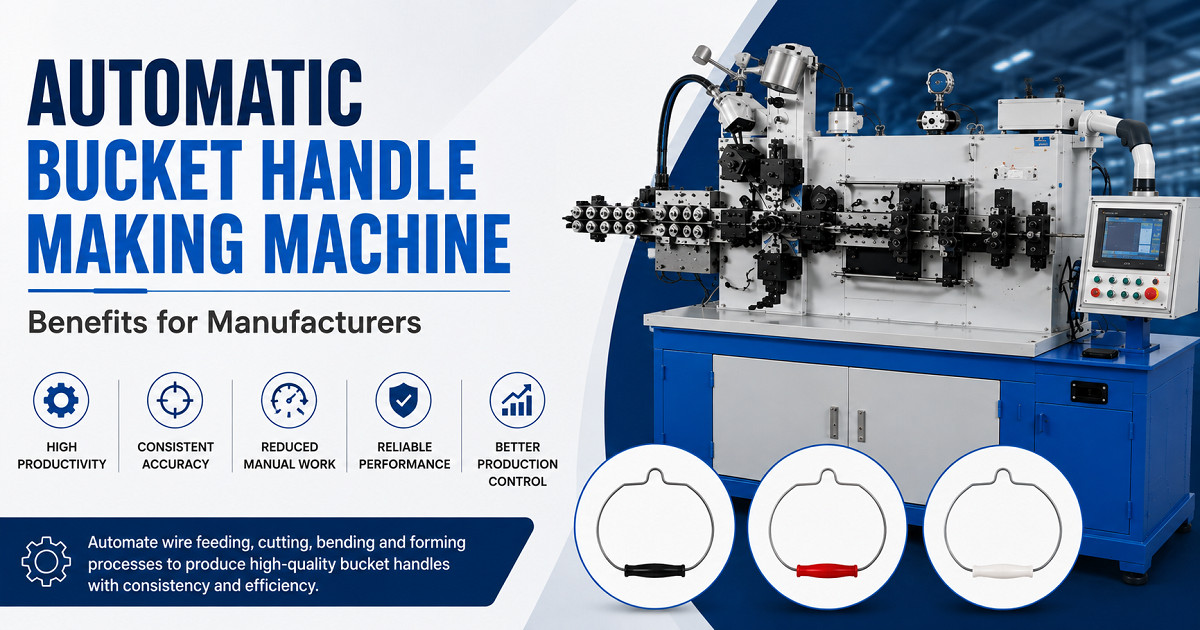
Manufacturing bucket handles at scale requires accuracy, consistency, and an efficient production process. As demand increases, manufacturers often look for ways to reduce repetitive manual operations and improve production workflow. An automatic bucket handle making machine can help streamline several stages of wire-handle production.
What Is an Automatic Bucket Handle Making Machine?
An automatic bucket handle making machine is designed to perform multiple wire-processing operations required to produce bucket handles. Depending on the machine configuration, these operations can include wire feeding, straightening, cutting, bending, and forming.
By automating repetitive processes, manufacturers can establish a more consistent production workflow and reduce dependence on manual handling.
How Does It Work?
The basic production process generally involves:
Wire Feeding: Wire is continuously supplied to the machine.
Straightening: The wire is straightened before forming.
Cutting: Wire is cut according to the required handle dimensions.
Bending: The cut wire is bent into the required shape.
Forming: The final handle shape is produced according to the required design.
The exact process and machine configuration depend on the handle type, wire specifications, and production requirements.
Benefits of Automatic Production
Consistent Handles
Automated cutting and forming can help maintain more consistent handle dimensions and shapes across production batches.
Improved Productivity
Automation can streamline repetitive manufacturing operations and support higher production requirements.
Reduced Manual Work
Multiple processes can be integrated into one machine, reducing repetitive manual operations.
Better Production Control
Manufacturers can work with defined machine settings and production parameters to achieve repeatable results.
Suitable for Different Applications
Depending on the machine design, automatic wire-forming equipment can be used for handles required for paint buckets, pails, cans, drums, and other containers.
Automatic vs Manual Bucket Handle Production
Manual production may be suitable for limited requirements, while automated machinery can be more useful for manufacturers handling regular or larger production volumes.
Before choosing an automatic bucket handle machine, manufacturers should consider:
- Required production volume
- Wire diameter and material
- Handle dimensions
- Handle design
- Level of automation
- Customization requirements
- Machine maintenance and technical support
Choosing the Right Bucket Handle Machine
There is no single machine configuration suitable for every manufacturer. The right solution depends on the required handle design, wire specifications, production volume, and manufacturing process.
An experienced bucket handle making machine manufacturer can evaluate these requirements and recommend an appropriate machine configuration.
Conclusion
An automatic bucket handle making machine can help manufacturers create a more organized and consistent production process. Automated wire feeding, cutting, bending, and forming can reduce repetitive manual work while improving production control.
Before investing in machinery, manufacturers should clearly define their handle specifications, production requirements, automation needs, and technical support expectations.